

Get a Custom Quote
Adaptive Sports in Corporate Events
Instead of simply hosting another meeting, companies have the opportunity to integrate corporate social responsibility into their agenda by engaging with adaptive sports programs.
These experiences allow teams to connect, collaborate, and grow in an environment that promotes inclusion, resilience, and social impact. By combining professional gatherings with adaptive sports activities, organizations can support this initiative, raise awareness, and contribute to a more inclusive society.
Adaptive Sport Options
Corporate Meeting Options
The sports centre is equipped with a plenary session room for 240 persons in theatre style or 120 persons capacity for a sit-down dinner.
2nd room with capacity for 45 persons in theatre style or 22 in boardroom setup.
3rd room with capacity for 60 theatre setup or U-shape setup for 22 persons.
4th room has a capacity of 10 people which can be used as the administration room or a breakout room.
All locker rooms have been used as breakout rooms in the past. There’s that option as well.
There are outdoor areas that can be used for a “borrel” or after-work drinks and snacks. Alternatively, the sports centre is equipped with BBQ, bar for beverages and a sitting area.
The meeting rooms are equipped with audio-visual equipment.
Other room setups and configurations are available, please inquire.
Corporate Social Responsibility Program
Sports Clinics
Our clinics allow participants to experience what it is like to play sports with a disability,
such as sitting volleyball, wheelchair basketball and blind football.
Typical Schedule
30 minutes: Introduction to adaptive sports and the initiative in Amsterdam by its founder. Get to know each other.
30 minutes to 1 hour: Depending on the size of the group:
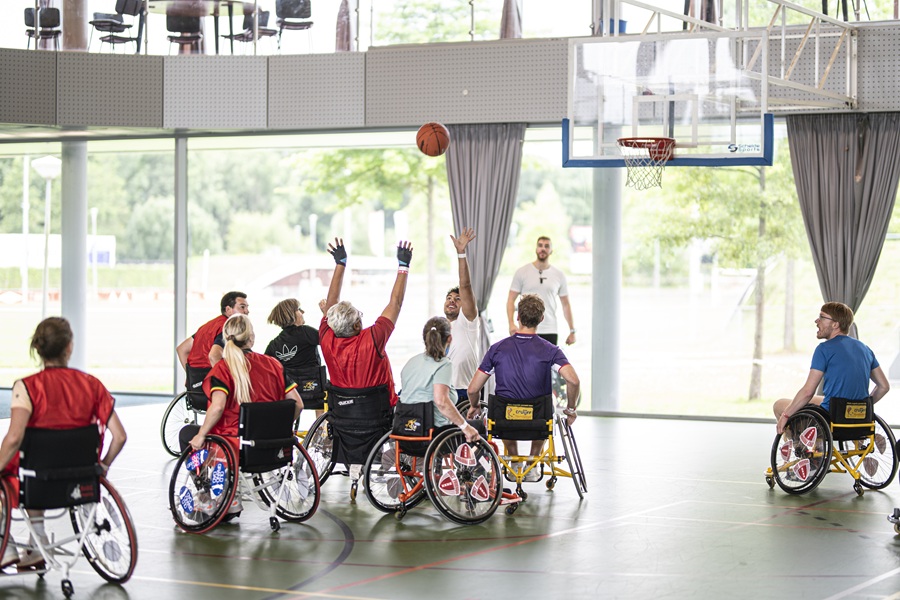
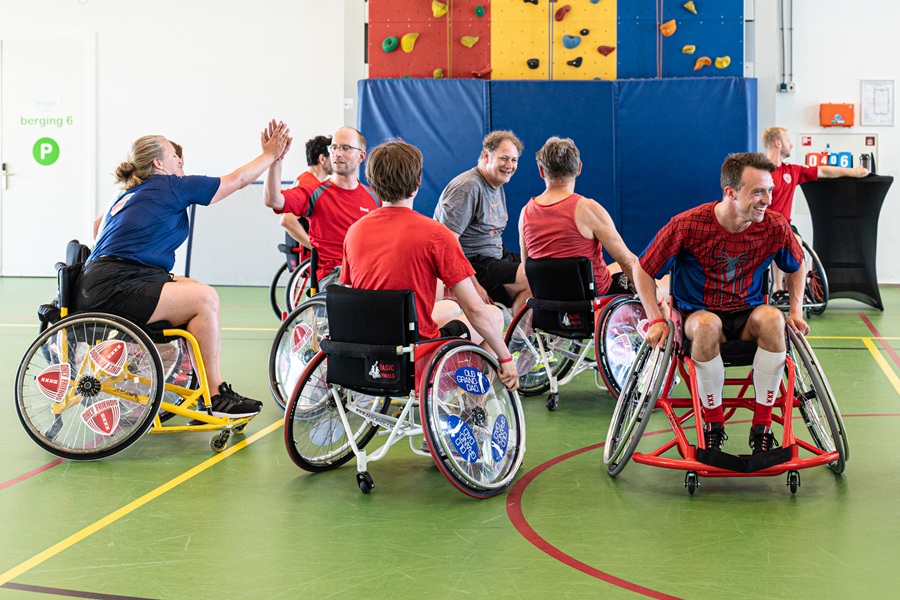
Wheelchair basketball
Sitting volleyball
Blind football.
30 minutes to 1 hour: Activity debrief, “borrel”/team drinks and snacks
Wheelchair basketball is a fast-paced, inclusive sport played by two teams of five. While it follows many of the same principles as stand-up basketball—including the same court size and 10-foot hoop height—it features unique adaptations for movement and classification.
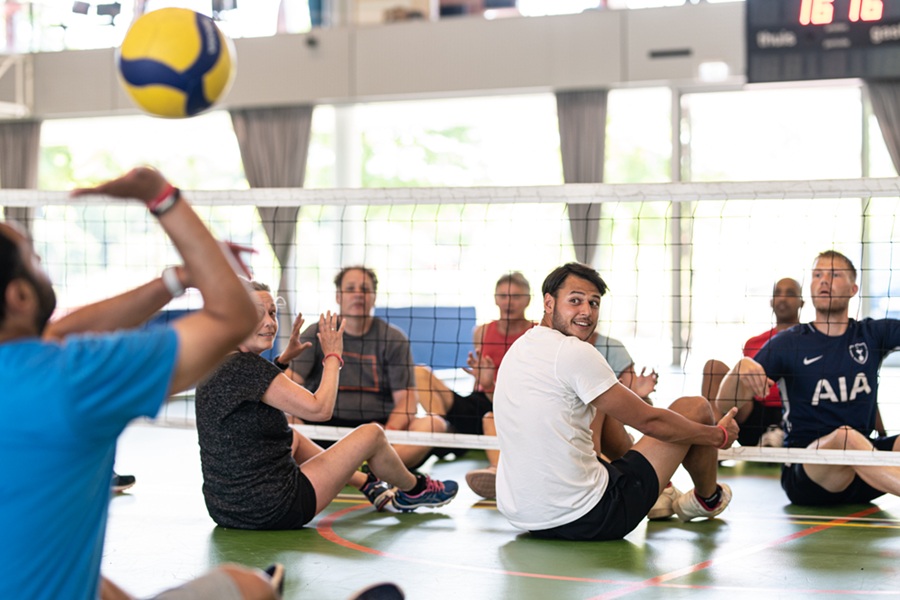
The “Buttock” RuleThe most important distinction in sitting volleyball is the contact rule. To ensure fair play: Constant Contact: At least one part of the player’s torso (between the buttocks and the shoulders) must maintain contact with the floor whenever they touch the ball.
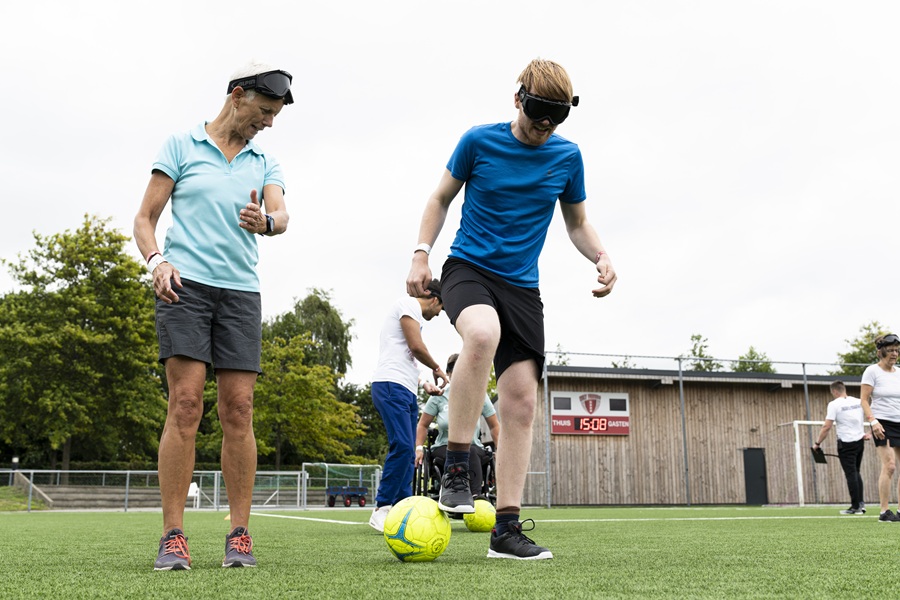
Blind Football is played with five players, four blind players and a sighted goalkeeper. The ball contains loose ball-bearings so it rattles when it moves, allowing the players to locate it as they play. Blind football, is an adaptation of football for athletes with a visual impairment.
Introduction to Wheelchair Basketball
1. Introduction
Wheelchair basketball is a fast-paced, inclusive sport played by two teams of five. While it follows many of the same principles as stand-up basketball—including the same court size and 10-foot hoop height—it features unique adaptations for movement and classification.
2. Core Gameplay & Rules
To help users understand the flow of the game, highlight these essential rules:
The Dribbling & Travel Rule: A player can push their wheelchair twice before they must dribble, pass, or shoot. Taking three or more pushes without dribbling is a traveling violation.
Seated Requirement: Players must remain firmly in their seats. Lifting out of the chair or using legs to gain an advantage (e.g., to shoot or reach a rebound) results in a technical foul.
Contact & The Chair: In this sport, the wheelchair is considered an extension of the player’s body. Standard basketball fouls like charging and blocking apply to chair-to-chair contact.
Shot Clock: Teams have 24 seconds from gaining possession to attempt a shot that hits the rim.
3. Understanding the Classification System
For competitive fairness, players are assigned a point value based on their functional ability:
Scale: Points range from 1.0 (least physical function) to 4.5 (most physical function).
Able-bodied Players: In recreational and local leagues, able-bodied players are often assigned 4.5 or 5.0 points.
Team Limit: The total value of the five players on the court cannot exceed a set limit, typically 14 to 15 points, ensuring a balanced mix of abilities on every team.
4. Specialized Equipment
A dedicated section on equipment is great for SEO keywords like “sports wheelchair” and “wheelchair basketball gear”:
Sports Wheelchairs: These are lightweight and highly maneuverable, often featuring cambered (angled) wheels for stability during quick turns.
Safety Features: Most sports chairs include small anti-tip casters at the back to prevent players from falling backward during aggressive play.
5. Essential Skills for New Players
Focus on these three areas for a “how-to” guide:
Chair Control: Practice starting, stopping, and turning using sharp, short pushes.
Ball Handling: Learn to dribble while pushing by placing the ball in your lap between bounces.
Shooting Mechanics: Because you are shooting from a seated position, emphasize upper-body strength and “hand in the cookie jar” follow-through.
Introduction to Sitting Volleyball
1. The Golden Rule:
The “Buttock” RuleThe most important distinction in sitting volleyball is the contact rule. To ensure fair play:
Constant Contact: At least one part of the player’s torso (between the buttocks and the shoulders) must maintain contact with the floor whenever they touch the ball.
Lifting: Players are not allowed to “lift” or stand up to block or attack.
2. Court and Net Dimensions
Sitting volleyball is played on a smaller court, which makes the game much faster than the standing version:
Court Size: 10 x 6 meters (divided into two 5x6m halves).
Net Height: The net is set much lower—1.15 meters for men and 1.05 meters for women.
The Attack Line: The attack line is 2 meters from the center line.
3. Key Rule Differences
While the objective is the same (be the first to 25 points, winning by 2), there are two major rule changes from standing volleyball:
Blocking the Serve: Unlike in standing volleyball, players are allowed to block the opponent’s serve at the net.
Positions: Positions are determined by the contact point of the buttocks on the floor, not the feet or hands.
4. Classification & Inclusivity
In official Paralympic competition, players are classified based on their level of impairment. However, in many national leagues (including the Netherlands):
Mixed Teams: Able-bodied players and athletes with disabilities often compete together.
Accessibility: Because the game is played on the floor, it levels the playing field, making it one of the most inclusive team sports in the world.
5. Essential Skills for Sitting Volleyball
If you’re just starting out, focus on these three core areas:
Movement (The Scoot): Since you can’t use your legs to run, you must use your arms to “scoot” across the floor. Quick hand-eye coordination is vital to move into position before the ball arrives.
Seated Power: Without the ability to jump, all power comes from the core and shoulders. Focus on a high contact point for serves and spikes.
Defensive Reaction: Because the court is small and the net is low, the ball travels very quickly. Fast reflexes are essential for “digging” the ball off the floor.
Introduction to Blind Football
1. The Equipment: The “Sound” of the Game
The most distinct feature of blind football is the ball itself.
The Audible Ball: The ball is filled with internal ball bearings or bells. This allows players to track its location and movement entirely by sound.
Eyeshades: To ensure total fairness (as some players may have slight light perception), all four outfield players must wear blackout eyeshades.
No Shin Guards? While shin guards are used, players often wear protective headgear to prevent injuries during head-to-head collisions.
2. Team Structure & The “Sighted” Roles
A team consists of five players, but not everyone on the pitch is blind:
The Outfielders: Four players who are classified as B1 (completely blind).
The Goalkeeper: The goalkeeper is sighted (or partially sighted). They cannot leave their small penalty area but play a crucial role in organizing the defense.
The Guides: There are “guides” stationed behind the opponent’s goal and on the sidelines to shout instructions and help players orient themselves.
3. Essential Rules: “Voy! Voy! Voy!”
To keep players safe and the game flowing, Blind Football has unique vocal requirements:
The “Voy” Rule: When a player is moving toward an opponent to tackle or challenge for the ball, they must shout the word “Voy!” (Spanish for “I’m coming”). This alerts the ball carrier to their position to prevent dangerous collisions. Failure to say “Voy” results in a foul.
Silence in the Stands: Unlike traditional football, the crowd must remain completely silent during play so players can hear the ball and the guides. Cheering is only allowed after a goal is scored.
No Offsides: There is no offside rule in blind football, leading to fast-paced, end-to-end action.
4. The Pitch LayoutDimensions:
The pitch is 40m x 20m (the size of a Futsal court).Sideboards: The sidelines are fitted with kickboards. These keep the ball in play constantly and help players navigate the pitch by “feeling” the boards with their feet or hearing the ball bounce off them.
5. Why It’s Great for Inclusivity
Blind Football emphasizes communication, mutual trust among your team members and the other team, and sensory perception.
Adaptive Sports in Corporate Events
Instead of simply hosting another meeting, companies have the opportunity to integrate corporate social responsibility into their agenda by engaging with adaptive sports programs. These experiences allow teams to connect, collaborate, and grow in an environment that promotes inclusion, resilience, and social impact.
Adaptive Sport Options
Building on this experience, SkyMar DMC now integrates adaptive sports such as wheelchair basketball, sitting volleyball, and blind football into its CSR (Corporate Social Responsibility) programs, offering them as inclusive and engaging team-building activities combined with corporate meetings. This approach not only enriches the event itself but also strengthens team cohesion, boosts employee engagement, and aligns company values with tangible action.
Corporate Meeting Options
The sports centre is equipped with a plenary session room for 240 persons in theatre style or 120 persons capacity for a sit-down dinner.
2nd room with capacity for 45 persons in theatre style or 22 in boardroom setup.
3rd room with capacity for 60 theatre setup or U-shape setup for 22 persons.
4th room has a capacity of 10 people which can be used as the administration room or a breakout room.
All locker rooms have been used as breakout rooms in the past. There’s that option as well.
There are outdoor areas that can be used for a “borrel” or after-work drinks and snacks. Alternatively, the sports centre is equipped with BBQ, bar for beverages and a sitting area.
The meeting rooms are equipped with audio-visual equipment.
Other room setups and configurations are available, please inquire.
Corporate Social Responsibility Program
Sports Clinics
Our clinics allow participants to experience what it is like to play sports with a disability,
such as sitting volleyball, wheelchair basketball and blind football.
Typical Schedule
30 minutes: Introduction to adaptive sports and the initiative in Amsterdam by its founder. Get to know each other.
30 minutes to 1 hour: Depending on the size of the group:
Wheelchair basketball
Sitting volleyball
Blind football.
30 minutes to 1 hour: Activity debrief, “borrel”/team drinks and snacks
Get a Custom Quote
Wheelchair basketball is a fast-paced, inclusive sport played by two teams of five. While it follows many of the same principles as stand-up basketball—including the same court size and 10-foot hoop height—it features unique adaptations for movement and classification.
The “Buttock” RuleThe most important distinction in sitting volleyball is the contact rule. To ensure fair play: Constant Contact: At least one part of the player’s torso (between the buttocks and the shoulders) must maintain contact with the floor whenever they touch the ball.
Blind Football is played with five players, four blind players and a sighted goalkeeper. The ball contains loose ball-bearings so it rattles when it moves, allowing the players to locate it as they play. Blind football, is an adaptation of football for athletes with a visual impairment.
Introduction to Wheelchair Basketball
1. Introduction
Wheelchair basketball is a fast-paced, inclusive sport played by two teams of five. While it follows many of the same principles as stand-up basketball—including the same court size and 10-foot hoop height—it features unique adaptations for movement and classification.
2. Core Gameplay & Rules
To help users understand the flow of the game, highlight these essential rules:
The Dribbling & Travel Rule: A player can push their wheelchair twice before they must dribble, pass, or shoot. Taking three or more pushes without dribbling is a traveling violation.
Seated Requirement: Players must remain firmly in their seats. Lifting out of the chair or using legs to gain an advantage (e.g., to shoot or reach a rebound) results in a technical foul.
Contact & The Chair: In this sport, the wheelchair is considered an extension of the player’s body. Standard basketball fouls like charging and blocking apply to chair-to-chair contact.
Shot Clock: Teams have 24 seconds from gaining possession to attempt a shot that hits the rim.
3. Understanding the Classification System
For competitive fairness, players are assigned a point value based on their functional ability:
Scale: Points range from 1.0 (least physical function) to 4.5 (most physical function).
Able-bodied Players: In recreational and local leagues, able-bodied players are often assigned 4.5 or 5.0 points.
Team Limit: The total value of the five players on the court cannot exceed a set limit, typically 14 to 15 points, ensuring a balanced mix of abilities on every team.
4. Specialized Equipment
A dedicated section on equipment is great for SEO keywords like “sports wheelchair” and “wheelchair basketball gear”:
Sports Wheelchairs: These are lightweight and highly maneuverable, often featuring cambered (angled) wheels for stability during quick turns.
Safety Features: Most sports chairs include small anti-tip casters at the back to prevent players from falling backward during aggressive play.
5. Essential Skills for New Players
Focus on these three areas for a “how-to” guide:
Chair Control: Practice starting, stopping, and turning using sharp, short pushes.
Ball Handling: Learn to dribble while pushing by placing the ball in your lap between bounces.
Shooting Mechanics: Because you are shooting from a seated position, emphasize upper-body strength and “hand in the cookie jar” follow-through.
Introduction to Sitting Volleyball
1. The Golden Rule:
The “Buttock” RuleThe most important distinction in sitting volleyball is the contact rule. To ensure fair play:
Constant Contact: At least one part of the player’s torso (between the buttocks and the shoulders) must maintain contact with the floor whenever they touch the ball.
Lifting: Players are not allowed to “lift” or stand up to block or attack.
2. Court and Net Dimensions
Sitting volleyball is played on a smaller court, which makes the game much faster than the standing version:
Court Size: 10 x 6 meters (divided into two 5x6m halves).
Net Height: The net is set much lower—1.15 meters for men and 1.05 meters for women.
The Attack Line: The attack line is 2 meters from the center line.
3. Key Rule Differences
While the objective is the same (be the first to 25 points, winning by 2), there are two major rule changes from standing volleyball:
Blocking the Serve: Unlike in standing volleyball, players are allowed to block the opponent’s serve at the net.
Positions: Positions are determined by the contact point of the buttocks on the floor, not the feet or hands.
4. Classification & Inclusivity
In official Paralympic competition, players are classified based on their level of impairment. However, in many national leagues (including the Netherlands):
Mixed Teams: Able-bodied players and athletes with disabilities often compete together.
Accessibility: Because the game is played on the floor, it levels the playing field, making it one of the most inclusive team sports in the world.
5. Essential Skills for Sitting Volleyball
If you’re just starting out, focus on these three core areas:
Movement (The Scoot): Since you can’t use your legs to run, you must use your arms to “scoot” across the floor. Quick hand-eye coordination is vital to move into position before the ball arrives.
Seated Power: Without the ability to jump, all power comes from the core and shoulders. Focus on a high contact point for serves and spikes.
Defensive Reaction: Because the court is small and the net is low, the ball travels very quickly. Fast reflexes are essential for “digging” the ball off the floor.
Introduction to Blind Football
1. The Equipment: The “Sound” of the Game
The most distinct feature of blind football is the ball itself.
The Audible Ball: The ball is filled with internal ball bearings or bells. This allows players to track its location and movement entirely by sound.
Eyeshades: To ensure total fairness (as some players may have slight light perception), all four outfield players must wear blackout eyeshades.
No Shin Guards? While shin guards are used, players often wear protective headgear to prevent injuries during head-to-head collisions.
2. Team Structure & The “Sighted” Roles
A team consists of five players, but not everyone on the pitch is blind:
The Outfielders: Four players who are classified as B1 (completely blind).
The Goalkeeper: The goalkeeper is sighted (or partially sighted). They cannot leave their small penalty area but play a crucial role in organizing the defense.
The Guides: There are “guides” stationed behind the opponent’s goal and on the sidelines to shout instructions and help players orient themselves.
3. Essential Rules: “Voy! Voy! Voy!”
To keep players safe and the game flowing, Blind Football has unique vocal requirements:
The “Voy” Rule: When a player is moving toward an opponent to tackle or challenge for the ball, they must shout the word “Voy!” (Spanish for “I’m coming”). This alerts the ball carrier to their position to prevent dangerous collisions. Failure to say “Voy” results in a foul.
Silence in the Stands: Unlike traditional football, the crowd must remain completely silent during play so players can hear the ball and the guides. Cheering is only allowed after a goal is scored.
No Offsides: There is no offside rule in blind football, leading to fast-paced, end-to-end action.
4. The Pitch LayoutDimensions:
The pitch is 40m x 20m (the size of a Futsal court).Sideboards: The sidelines are fitted with kickboards. These keep the ball in play constantly and help players navigate the pitch by “feeling” the boards with their feet or hearing the ball bounce off them.
5. Why It’s Great for Inclusivity
Blind Football emphasizes communication, mutual trust among your team members and the other team, and sensory perception.
Adaptive Sports - Frequently Asked Questions - FAQ
1. General Knowledge
What are adaptive sports?
Adaptive sports (also known as para-sports) are competitive or recreational sports for people with disabilities. These sports are often modified from existing versions to allow for different physical or intellectual abilities, using specialized equipment like sports wheelchairs, audible balls, or handcycles.
Can able-bodied people play adaptive sports?
2. Popular Adaptive Sports
What are the most popular adaptive sports in the Netherlands?
Popular options include:
Wheelchair Basketball: A high-speed, tactical team sport.
Sitting Volleyball: A fast-paced game played on a smaller court with a lower net.
Blind Football: A sport for players with visual impairments, played on a 40x20m pitch with sideboards, an audible ball (containing bells), and a silenced crowd. All players wear a blindfold.
Para-cycling: Including handcycling, which is very popular on Dutch cycling paths.
Wheelchair Tennis: A sport where the Netherlands is a global powerhouse.
What is the "classification system" in adaptive sports?
3. Logistics
Do I need a special wheelchair to play?
Is sitting volleyball harder than standing volleyball?
Why do I need to wear a blindfold for blind football?
3. Coporate Meeting and Events
How many meeting rooms there are at the sports centre?
2nd room with capacity for 45 persons in theatre style or 22 in boardroom setup.
3rd room with capacity for 60 theatre setup or U-shape setup for 22 persons.
4th room has a capacity of 10 people which can be used as the administration room or a breakout room.
All locker rooms have been used as breakout rooms in the past. There’s that option as well.
The meeting rooms are equipped with audio-visual equipment.
Other room setup configurations are available, please inquire.
Can food and beverage be arranged for our meeting?
Discover other activities
Ready to elevate your event and stand out?
Your event is full of possibilities —we’re here to unlock them.
Keep exploring our services
We take pride in what we do. Our services are end-to-end, covering program and attendee management, transportation, venue selection, and full logistical coordination. Discover the many other ways we can support you.
Connect with us
Let's talk
Have an activity idea? Tell us about it.
We’ll make it happen!